Variance (from Internet Glossary of Statistical Terms)
Statistics Explained
Variance

The variance is one of several indices of variability that statisticians use to characterize the dispersion among the measures in a given population. To calculate the variance of a given population, it is necessary to first calculate the mean of the scores, then measure the amount that each score deviates from the mean and then square that deviation (by multiplying it by itself). Numerically, the variance equals the average of the several squared deviations from the mean.

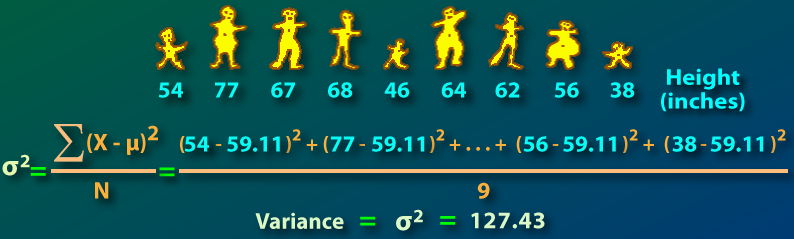
Image for Variance

Go to web page describing Statistics Explained

Only $19.95!

  • Learn the logic behind fundamental statistical concepts!
  • 100 modules -- Get a solid grounding in basic statistical reasoning!
  • Call us toll free to order a CD-ROM or use our Automated Secured Transaction System to download the complete program now.
  • Written by:
    Howard S. Hoffman, Professor Emeritus of Psychology, Bryn Mawr College
    Programming by:
    Russell D. Hoffman, Owner and Chief Programmer, The Animated Software Company

  • Click here for more information!


Catalog / Site Map / Company Home page / Contact / Product Home Page


Last modified February, 2002
Webmaster: Russell D. Hoffman
Copyright (c) Russell D. Hoffman