The statistic s² is a measure on a random sample that is used to estimate the variance of the population from which the sample is drawn.
Numerically, it is the sum of the squared deviations around the mean of a random sample divided by the sample size minus one.
Regardless of the size of the population, and regardless of the size of the random sample, it can be algebriacally shown that if we repeatedly took random samples of the same size from the same population and calculated the variance estimate on each sample, these values would cluster around the exact value of the population variance. In short, the statistic s² is an unbiased estimate of the variance of the population from which a sample is drawn.
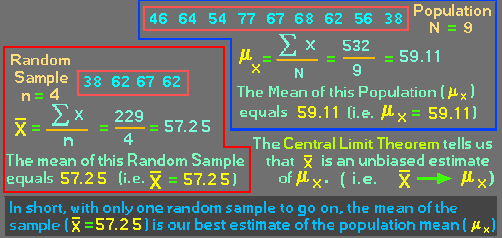
The illustration shows the formula for the calculation of s² and it provides an example of its calculation. It is a useful exercise to carry out these calculations by oneself.